
September 26, 2026
12 Interesting Fun Facts About Black Friday: History, Surprising Stories, and the Truth Behind
Every November, as Thanksgiving ends, Black Friday sets off a shopping tradition now celebrated around the world, one where consumers hunt for the best deals and retailers aim to boost year-end profits. In the U.S., shoppers spent an average of $337.86 each on holiday purchases over the five-day Thanksgiving weekend in 2025, fueling billions in sales both online and in stores. Yet beyond the excitement and savings, Black Friday also reflects broader themes, from evolving consumer behavior and digital transformation to growing awareness of its environmental impact.
So how did a single day of post-Thanksgiving sales turn into a week-long event that reshaped how people buy and how brands sell? These 12 fun facts about Black Friday tell the story behind the shopping frenzy.
The origin of the shopping event everyone’s waiting for
Black Friday as a shopping term first gained traction in the 1950s in the United States, when police in Philadelphia used it to describe the chaos caused by crowds of shoppers and tourists flooding the city the day after Thanksgiving. Retailers eventually reclaimed the phrase, transforming it into a symbol of opportunity rather than disorder.
Through the 1980s, “Black Friday” spread well beyond Philadelphia and became synonymous with big discounts and the start of the holiday shopping season. The name was also reinterpreted to represent stores “going into the black”, turning profits after a year of being “in the red.”
With the rise of eCommerce, the tradition evolved even further. Cyber Monday was born in 2005, extending the shopping frenzy into the digital world, and Black Friday deals often start well before the day itself, spanning continents and online marketplaces.
What began as a local shopping rush has become a global retail event that shapes consumer behavior, drives competition, and sets the tone for the holiday season each year.
Fact 1: Black Friday once meant a financial crash
Before it became synonymous with holiday deals, Black Friday had a very different meaning. It was a day of financial panic.
One of the earliest uses of the name came in 1869, when two Wall Street financiers, Jay Gould and James Fisk, attempted to manipulate the U.S. gold market. Their goal was to drive gold prices sky-high by buying massive amounts and creating artificial scarcity. For a while, it worked: prices soared, and investors rushed in hoping to profit.
But their plan unraveled quickly. The U.S. government stepped in, releasing large reserves of gold into the market to stabilize the economy. The sudden flood of supply caused gold prices to collapse rapidly, wiping out fortunes and sending a wave of panic through the stock market that rippled across the nation.
Businesses went bankrupt, farmers saw the value of their goods plummet, and Wall Street’s trust in financial stability was shaken. The day went down in history as “Black Friday.” Nearly a century later, the same name would be used for an unrelated kind of frenzy: retail shopping.
Fact 2: Police coined the term, not marketers
The story of modern Black Friday begins not in boardrooms or marketing agencies, but on the streets of Philadelphia in the 1950s.
Every year, the day after Thanksgiving, thousands of people poured into the city ahead of the Army-Navy football game held that Saturday. Downtown stores used the opportunity to run major sales, drawing even larger crowds of bargain hunters and tourists.
For local police, it was a nightmare. Traffic jams stretched for blocks, sidewalks were packed, and officers had to work overtime shifts to control the chaos and deal with shoplifters taking advantage of the crowds. Frustrated officers started calling the day “Black Friday”, not for profits, but for the headaches it caused.
Retailers didn’t like how gloomy the name sounded. Some even tried to rename it “Big Friday” to make it sound more upbeat, but the public never adopted it. Eventually, marketers found a smarter way to give the name a positive spin (more on that in Fact 12).
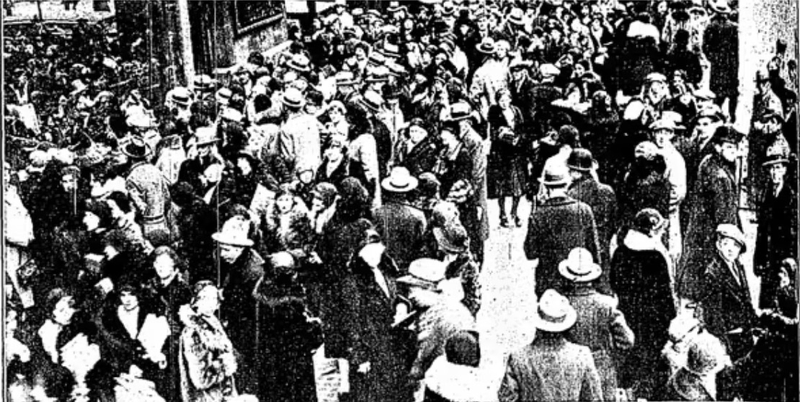
A nickname coined for chaos eventually became the name of one of the biggest shopping days in the world.
Fact 3: Retailers once convinced the president to move Thanksgiving
For decades before 1939, Thanksgiving was traditionally held on the last Thursday of November, a custom dating back to Abraham Lincoln. But that year, the date landed on November 30, leaving just 24 shopping days before Christmas. For retailers still recovering from the Great Depression, that shorter season meant fewer sales and lower profits.
Fearing the economic impact, major department stores and trade groups lobbied President Franklin D. Roosevelt to move Thanksgiving up by one week. Roosevelt agreed, hoping the extra shopping time would help boost spending and lift morale across the country.
The decision caused confusion at first, with some states refusing to change their holiday calendars. To end the debate, Congress stepped in, and Roosevelt signed a resolution on December 26, 1941 fixing Thanksgiving on the fourth Thursday of November from 1942 onward. The change helped establish the modern Thanksgiving calendar and shaped the timing of the holiday shopping season.
Fact 4: Plumbers call it “Brown Friday”
While shoppers rush to stores for Black Friday deals, plumbers across the U.S. deal with a rush of their own, one they jokingly call “Brown Friday.”
At Roto-Rooter, the largest plumbing repair and drain service provider in the U.S., service calls jump 50% above an average Friday the day after Thanksgiving. The reason? Thanksgiving dinners put enormous strain on household pipes and garbage disposals. Grease, turkey fat, potato peels, and other food scraps often end up down the drain, where they quickly cause blockages and backups. Add in more guests using bathrooms and showers, and it’s a perfect recipe for plumbing chaos.
Most of these calls aren’t for major disasters, just the result of holiday overuse and poor disposal habits. Still, the surge is so consistent that many plumbers treat it like their own version of Black Friday. It’s a funny reminder that while one part of the economy is driven by shopping sprees, another thrives on fixing the messy aftermath of Thanksgiving feasts.
Fact 5: It’s one of the riskiest days to drive
Black Friday doesn’t just test shoppers’ patience; it also tests their driving skills. Progressive’s claims data shows car accidents rising 34% on Black Friday compared with the two weeks before and after.
Parking lots are a common trouble spot: backing and parking incidents made up 31% of Black Friday claims, more than any other claim type. Tired, distracted drivers circling for limited spaces, plus heavy foot traffic and early-morning rushes, make fender benders and shopping cart collisions all too common.
So if you’re heading out for doorbusters, slow down in the parking lot: a few extra minutes of patience can save a lot more than the cost of a good deal.
Fact 6: Some shoppers would hit the sales… even while buzzed
Some shoppers will go to surprising lengths for a deal. In a 2014 survey for RetailMeNot, about 1 in 8 Thanksgiving Day shoppers (12%) said they would even shop under the influence of alcohol to snag pre-Black Friday deals.
It’s a lighthearted reminder that while a drink might make you feel generous, your credit card might not thank you later.
Fact 7: The $5 deal that gave buyers absolutely nothing
Not every Black Friday deal involves getting more for less; sometimes it’s the opposite. In one of the most memorable marketing stunts ever, the creators of the popular party game Cards Against Humanity launched a 2015 Black Friday “deal” that offered buyers absolutely nothing for $5.
The company temporarily removed all its products from its website and replaced them with a single payment form: “Give Cards Against Humanity $5.” To everyone’s surprise, 11,248 people actually paid, generating $71,145 in total, for no product, no service, and no promise of anything in return.
The stunt was both a social experiment and a clever commentary on consumer culture. Cards Against Humanity later revealed they split the money among their employees, even sharing how each person spent their cut, on things like donations, personal gadgets, and paying off debts. It proved a simple point: on Black Friday, people aren’t just buying products, they’re buying into the experience, humor, and hype of the moment.
Fact 8: Black Friday crowds keep breaking records
If you’ve ever been stuck in a sea of shoppers on Black Friday, you’re not imagining the scale. A record 202.9 million Americans shopped in stores or online from Thanksgiving Day through Cyber Monday in 2025, and about 80.3 million of them went to stores nationwide on Black Friday alone. Even the Sunday after Thanksgiving set a record, with 32.6 million in-store shoppers, up 27% from 2024.
These massive turnouts show just how deeply Black Friday has become embedded in U.S. culture, not just as a shopping event, but as a shared social experience. For many families, it’s as much a post-Thanksgiving tradition as turkey leftovers, a day to hunt for deals, people-watch, and kick off the holiday season together.
Fact 9: The birth of Cyber Monday
As online shopping began to take off in the early 2000s, retailers realized that not everyone wanted to face the crowds and chaos of Black Friday. To capture those shoppers, marketers coined a new term: “Cyber Monday.” The phrase was introduced in 2005 by Shop.org, the digital division of the National Retail Federation (NRF), after noticing a sharp rise in online sales on the Monday following Thanksgiving, when people returned to work and shopped from their office computers.
The idea caught on immediately. Retailers began offering exclusive online-only deals, making Cyber Monday the digital twin of Black Friday. In 2025, U.S. shoppers spent a record $14.25 billion online on Cyber Monday, while the five days from Thanksgiving to Cyber Monday brought in $44.2 billion online. Once a marketing experiment, Cyber Monday is now the peak of the holiday eCommerce season.
The event has also evolved alongside the technology people use to shop. Adobe’s 2025 holiday shopping data shows that more than half of U.S. online holiday purchases happened on mobile devices, and Salesforce found that AI tools and agents influenced one in five Cyber Week orders worldwide.
The holiday shopping season also starts earlier than many people think. By early November 2025, shoppers had already completed about a quarter of their planned holiday purchases, and as of Thanksgiving weekend, 84% had begun their holiday shopping. In other words, Black Friday is no longer the starting line, so merchants need to prepare well before the deals go live. If you sell through a mobile app, our mobile app checklist for BFCM can help you get ready before traffic peaks.
Fact 10: Black Friday goes global
Black Friday has long since outgrown its American roots. Since the early 2010s, it has spread far beyond the United States, embraced by shoppers and retailers in the U.K., Canada, Australia, Germany, France, South Africa, and dozens of other countries.
In the United Kingdom, Amazon introduced Black Friday deals in 2010, and Walmart-owned Asda turned the day into an in-store frenzy in 2013. In 2025, UK retail spending over the four days from Black Friday to Cyber Monday was forecast by Cebr at around £7 billion. Canada adopted it as a way to keep local shoppers from crossing the border for U.S. deals, while Australia and New Zealand quickly followed as eCommerce grew.
Each region gives the event its own twist, from Brazil’s week-long “Black Week”, which grew out of its first Black Friday in 2010, to Jumia’s month-long Black Friday festival in Nigeria. Online platforms have helped connect these markets: Shopify’s BFCM 2025 results show that more than 81 million customers worldwide bought from Shopify-powered brands, and cross-border orders made up 16% of all orders.
Fact 11: The hidden cost of overconsumption
Behind the excitement and record-breaking sales, Black Friday has a significant environmental and social cost. The massive surge in production, packaging, shipping, and returns creates enormous waste and carbon emissions. The Dirty Delivery Report by money.co.uk projected that online deliveries from Black Friday 2020 in the U.K. would release around 429,000 metric tons of CO₂, roughly the same as 435 return flights between London and New York. The figure was a forecast made before the sales, not a measured total. A report by Green Alliance and the University of Leeds also estimated that up to 80% of items bought on Black Friday end up in landfill, incineration, or low-quality recycling, often after a very short life.
On top of the environmental toll, the day also puts intense pressure on supply chains and retail workers. Warehouse staff, delivery drivers, and store employees often face extended hours, unrealistic quotas, and stressful working conditions to keep up with demand.
These realities have inspired a growing “conscious consumer” movement, where shoppers choose to buy less, shop local, or support ethical brands. Many companies are also responding by promoting sustainable deals, recycled products, or even opting out of Black Friday entirely. It’s a reminder that while great discounts are tempting, mindful spending can have a far greater impact, for both people and the planet.
Fact 12: From red ink to black ink
The “red to black” story is the one most people know, but it came along well after the name itself. After years of being associated with chaos and stress, retailers promoted a more positive explanation of the name. In accounting, losses are traditionally recorded in red ink, while profits are written in black ink, and marketers cleverly used this idea to tell a new story. Instead of a day of traffic jams and disorder, they began promoting it as the moment when businesses finally moved “into the black”, turning a profit after months of slower sales.
As the term spread beyond Philadelphia during the 1980s, so did the more upbeat “red to black” story, which first appeared in print in 1981. It marked a psychological shift, both for retailers, who saw it as the official start of the holiday profit season, and for shoppers, who began to associate the day with winning deals and celebration, rather than chaos.
Today, the “red to black” story is a masterclass in marketing rebranding. It shows how language and perception can reshape an entire event’s meaning, transforming a day once dreaded by police and workers into a shopping tradition that symbolizes retail success.
Final thoughts
Black Friday has come a long way from its chaotic beginnings in 1950s Philadelphia. What started as a local shopping rush is now a global retail tradition, powered by eCommerce, social media, and consumer demand for instant savings. Behind the excitement, though, lies a growing awareness: shoppers are not just hunting for deals; they’re looking for value, transparency, and meaning.
As businesses continue to innovate with new technologies and sustainable practices, Black Friday will likely keep changing shape. Whether you see it as a celebration of commerce or a reminder to shop mindfully, one thing is certain: Black Friday reflects how our world shops, spends, and connects in the modern age.
FAQs
Is Black Friday called the same thing in every country?
No. In much of the Middle East, it’s called White Friday, a name Souq.com chose in 2014 out of respect for Friday as a day of worship. The sale usually runs for several days at the end of November.
Has any major retailer ever closed on Black Friday?
Yes. In 2015, outdoor retailer REI closed all 143 of its stores on Black Friday and gave its 12,000 employees a paid day off, encouraging people to spend the day outdoors through its #OptOutside campaign.
Is there a movement against Black Friday?
Yes. Buy Nothing Day is an annual protest against overconsumption, held on Black Friday in North America. Vancouver artist Ted Dave created it in 1992, and Adbusters magazine later moved it to Black Friday in 1997 to coincide with one of the busiest shopping days of the year.
Are Black Friday deals really worth it?
Many deals offer genuine discounts, but not all are as big as they seem. A year-long price study by a UK consumer group found that about eight in 10 Black Friday 2024 deals were the same price or cheaper at other times of the year. Shoppers can make the most of the day by comparing prices, checking reviews, and buying only what they truly need.

Alexandre Le
Content Specialist
“I'm Alexandre Le - a marketer with 5+ years of hands-on experience in the eCommerce industry. I want to use my expertise and personal perspectives to produce insightful blog posts that help online store owners to launch, run, and scale up their businesses successfully.”
Table of Contents
Table of Contents
Read more articles

Black Friday Push Notifications: The Ultimate BFCM 2026 Calendar
By Alexandre Le
November 1, 2026

26 Best Shopify Apps for Black Friday Cyber Monday [Hot Deals Included]
By Alexandre Le
October 28, 2026